




|
Wellhams |

|
What's What
|
|
Who's Who
|
Origins of the nameThe Wellham name can be traced back in England to its Saxon roots. The earliest documented evidence of the name in England is seen at ‘Wellham’s Brook’ and ‘Wellham’s Mill’, which occurs as the family name of Walter and Maud de Welnham in 1319 who owned the Mill at that time, which gives credence to the Mill being the same one documented in the Doomsday Book in 1068. The Mill lies near Yeovil to the south of the medieval hamlets of Pykesash and Ash Boulogne in Somerset. Wellham’s Brook and Mill may be the area given by King Edmund to Wilfric before 946, 15 years before Morwellham was built by the Benedictine Monks of Tavistock Abbey on the Cornish – Devon border. Morwellham on the Tamar 961AD (see Wellham Trivia). In this instance the Saxon name may have integrated with the Cornish Celtic language, ‘Mor’ means ‘Sea’ in Celtic Cornish, Wellham means ‘Spring hamlet’ in Saxon. Morwellham means Sea Wellham, perhaps a person named Wellham living by the sea establishing the hamlet with monks whose knowledge of Latin and both the Celtic and Saxon languages named the hamlet Morwellham. Further north east, the population of the village of Welham of Saxon origin, forming part of the Romano Britain Via Devana Divide, in the County of Leicestershire recorded in 1086, was only 16. In 1125, Welham of Leicestershire was of the houses of Augustinian Canons, ‘The Priory of Launde’. From the 11th to 15th centuries in Leicestershire and Somerset, the name is shown as Welham or Welland (see one ‘l’ of a difference) as seen in ‘Close Rolls’ a call to court by the king to his Barons such as Robert de Welham and may others over three centuries. The name later changes back to Wellham in the 1500’s through to the present day, as the name spread throughout the world during the colonisation of America, Australia, South Africa, the Pacific and during the time of British rule in India. |
|
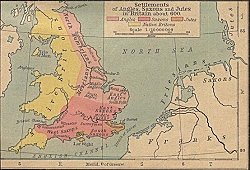
Anglo Saxon settlements circa 600AD |
Early derivationEarly traces of the person name Wellham can be found in Essex, Suffolk, Middlesex and Norfolk. It originally derives from the Saxon and Germanic vocabulary. The Anglo Saxons that arrived in England during 449 AD, named their settlements after their environment. |
|
For example, here are a few Anglo Saxon words which have been used, joined together to form place names: Dun meaning Hill, Ham meaning Homestead or Village, Worth, meaning Enclosure, Leah meaning clearing, Well meaning Spring or Spa and Ey meaning island. Of course, landscapes and river routes have changed since the 5th Century, so they may not relate to their surroundings today. |
|
|
The head of the Saxon tribe would be named after the village, much in the same way as other cultures, until the Normans came and names such as Robert de Welham appeared with the Latin influence via the Norsemen who settled in Northern France (Normandy). Other members of the village or Hamlet (Hamlet deriving from the Germanic word Ham) were named after their occupation, for example Smith the blacksmith and later Cooper, who would have made barrels. This was the case for many years in England, until as in Ireland Wales and Scotland the children carried the name of their father regardless to their future occupations, or positions. The names of settlements have, of course, been changed over the years, due to many different influences such as the Romans, Danish ruled areas, and The Norman invasion during 1066 onwards. The Anglo Saxon Germanic dialect was no longer prominent in some parts of England due to the merging with the French language. |
The
Anglo-Saxons, |
|
During a search I made into the 1901 Census for the Wellham name, I found some obvious Saxon/Germanic first names such as Hagar Wellham from Middlesex, Gertrude Wellham from Essex and Wilhelmina Wellham from Suffolk. There were many other Anglo Saxon first names, most of which still thrive today. The German connectionThe Germanic meanings were slightly different. Hamm meant settlement/meadow, or settlement enclosed by the bend of a river. The settlements of Wortham and Eye (meaning island in Saxon), exist today in Suffolk, as do many other settlements, villages and towns with Anglo Saxon names. The name Ey has changed to Eye and Wortham has contracted form Worth ham. In much the same way the name Wellham has, in some cases been shortened to Welham, as can be seen in place names called Welham today. |
|

The village of Wellheim in Germany |
|
| In modern
German the word for home, originally Ham is now Heim.
I have found a place in Germany called Wellheim.
It is situated amongst many tributaries, which lead to the
Rivers Danube and Altmuhl. It can be found on a map
between Munich and Nuremburg, on the crossroads of the
S2047 and E15. There are many other towns in Germany that
begin with 'Well' in northern Germany, formerly Saxony
such as Welle (meaning
sea/waves), Wellhaine, Wellen, Wellesweiler and many more.
All of them are associated with or near water. The people from the area of Wellheim would have made their way to the east coast of England by the river Rhein, which would have taken them directly to the coast at the Hague in Holland, for easy access to England and the now known Essex coast (East Saxony). Other similar German town names are, Weilham, Wallham, Weiglham and Waltham, the last of which is also a popular name for people and towns in England. Water associationThe descriptions for 'well' and 'ham' in the Oxford English Dictionary are, 'well', (4a) a mineral spring. (b) a spa. spring as from a fountain; flow copiously. [Old English], meaning abundant and plentiful. 'Ham' found under hamlet, is said to be based on the middle low German word 'hamm'. Consequently, because the name Wellham either means Water/ Spring/ Spa Village, or in Germanic, perhaps Spring Meadow, I have looked into the places named Wellham or Welham in England to see if there is a connection to water. |
|
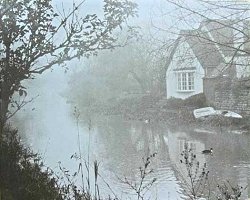
The River Welland in Leicestershire |
Welham in Leicestershire
has the River
Welland, which runs from south west below the
village, past the village to the east and away to the
north east. There is also a tributary to the west of the
village coming from the north, with another tributary
further to the south. The village of Welham in Nottinghamshire is west of Retford a town east of South Yorkshire. The tributary called Idle is to the west of the village, which flows into the River Trent. |
|
The village of Eye as mentioned earlier is a good example, to the east of the River Dove, which runs from the south west below Eye and then heads north into the River Waveney. There is another tributary to the north of Eye, which may have once encircled Eye, meaning island in Saxon. The places named after the Wellhams seem to be spread far and wide across England, and to other countries and continents. One 'L' of a differenceThe Wellham name has been linked with Welham and Wellum in previous census forms. The name Welham has shown up in the same household as Wellham in England during 18th and 19th centuries. A different spelling of the name is
apparent in the case of the Christening of Abigail
Wellum or Wellham, 24th March 1805 Diss Norfolk England.
Father Charles Wellum or Wellham and Mother Mary Anne
Grear. Early tracesSome of the earliest traces of the Wellham name include: |
|
|
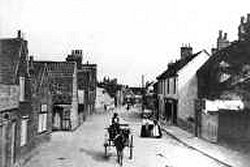
The village of Tollesbury in Essex |
Some early traces of the
name Welham between the 1300’s – 1500’s can be seen with a
prominent family living in and around Bury St Edmunds via
Wills and Testament registers which include
Mentions in Close Rolls (an order for barons to attend council) in date and King order:
|
|
Home | About | Contact | Links
Material Copyright © 2004-15
Disclaimer
